Redefining mental health care with immersive interactive experiences
WellNest Vision Glass • Apple Vision Pro • Mental Wellness
Product
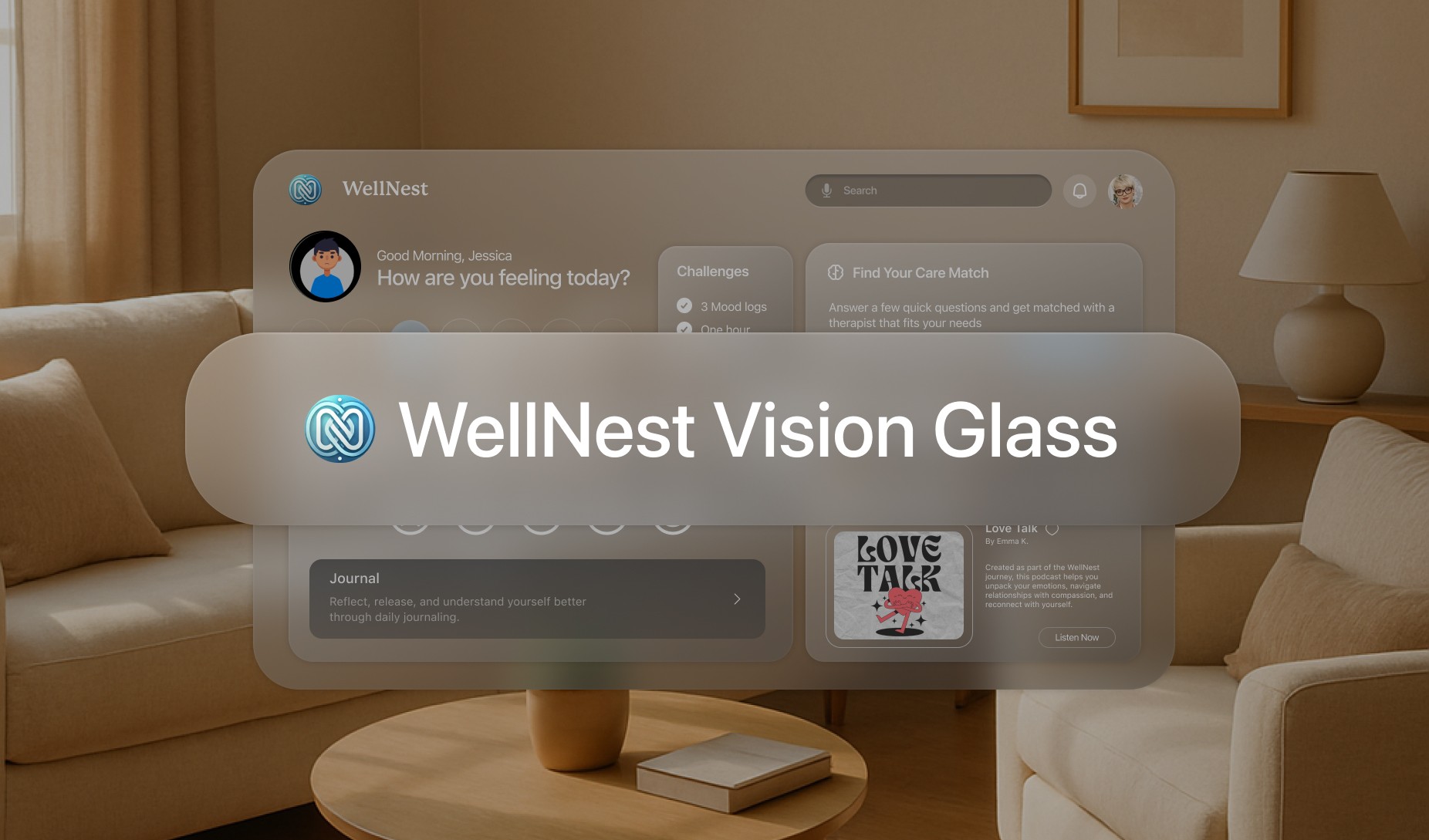
WellNest Vision Glass
Brings the WellNest app into Apple Vision Pro, creating an immersive space where therapy, self-care, and mindfulness blend into daily life.
Details
Product Designer
My Role
Apple Vision Pro spatial app
Surface
3 months (2025)
Timeline
Problem
Support That’s Hard to Reach
Busy professionals struggle to access timely mental health support, facing long wait times and difficulty finding the right therapist.
Solution
An Immersive Wellness Companion
Smart therapist matching, adaptive wellness exercises, and guided journaling, connected in one spatial experience.
Outcome
Continuous, Personal Support
A connected journey from self-guided care to professional support, designed to improve access, engagement, and long-term habits.
Expected Impact
Increased Accessibility
Faster access to support through intelligent therapist matching.
Improved Engagement
Higher interaction driven by immersive, personalized experiences.
Stronger Habits
Sustained routines supported by progress tracking and adaptive guidance.
OVERVIEW
✧ Background
Despite growing awareness, access to mental health support remains inconsistent and difficult to navigate.Mental health support is still hard to access and navigate.
WellNest Vision Glass reimagines wellness by bringing the WellNest app into Apple Vision Pro, creating an immersive space where therapy, self-care, and mindfulness seamlessly blend into daily life. With interactive sessions, personalized content, and a calming virtual environment, users can nurture their mental well-being anytime, anywhere.WellNest Vision Glass brings the WellNest app into Apple Vision Pro: an immersive space with interactive sessions, personalized content, and calming environments for mental well-being anytime.
✧ Problem & Key Insights
Many individuals, especially busy professionals, struggle to access timely mental health supportBusy professionals struggle to get timely mental health support.
Facing long wait times and difficulty finding the right therapists, users will need accessible personalized solutions that provide immediate support and integrate seamlessly into daily life.With long waits and hard-to-find therapists, users need personal, immediate support that fits into daily life.
Key Insights Identified
Limited Accessibility to Support
Users need fast, frictionless ways to connect with therapists and mental health resources.
Lack of Adaptive Personalization
Users require tailored guidance that adapts to their emotional state and progress over time.
Low Engagement and Motivation
Users struggle to maintain consistent wellness habits without feedback, progress visibility, and reinforcement.
RESEARCH
✧ Research
90%
Of Gen Z experiencing physical or emotional symptoms due to stress.
50%
Of adults with mental health conditions receive treatment in the United States.
50%
Of patients begin showing signs of mental illness by age 14, often not recognized until decade later.
✧ Product Goal
To build an accessible mental health platform that connects users with support anytime, anywhere.An accessible mental health platform, available anytime, anywhere.
By leveraging spatial interaction through gestures and immersive environments, the platform aims to create a more engaging and emotionally supportive experience compared to traditional mobile applications.Spatial gestures and immersive environments make support feel more engaging and emotionally present than a phone app.
✧ Competitor Insights
Existing mental health platforms address parts of the problem but rarely provide a cohesive end-to-end support experience.Existing platforms solve parts of the problem, not the whole journey.


Competitive Insights
Limited Personalization Over Time
Personalization tends to be static, with minimal adaptation based on user behavior, emotional state, or progress.
Passive Screen-Based Experiences
Interactions rely heavily on traditional mobile interfaces, limiting engagement and immersion.
Low Long-Term Engagement
Users struggle to maintain wellness habits without feedback, progress visibility, or reinforcement.
These gaps highlighted an opportunity to design a more adaptive and immersive mental health experience through WellNest.
STRATEGY
✧ Translating Insights into Solutions
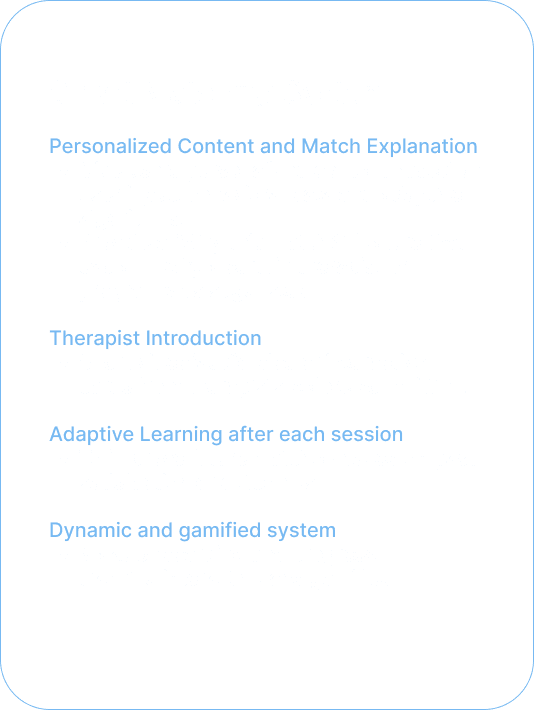
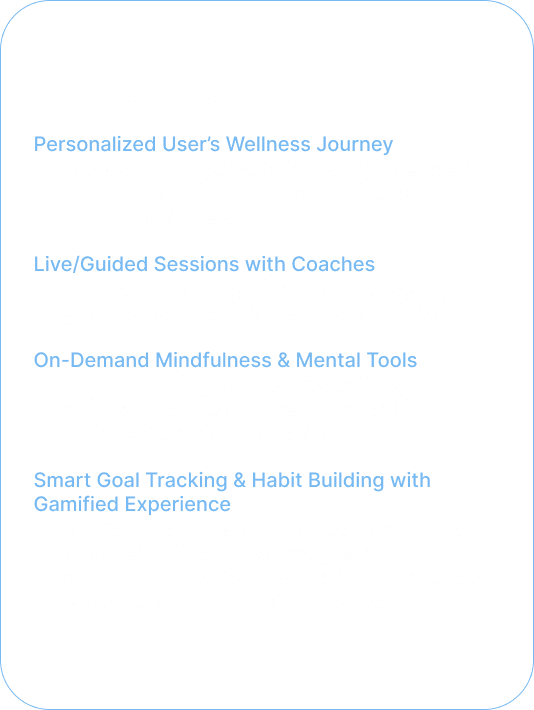
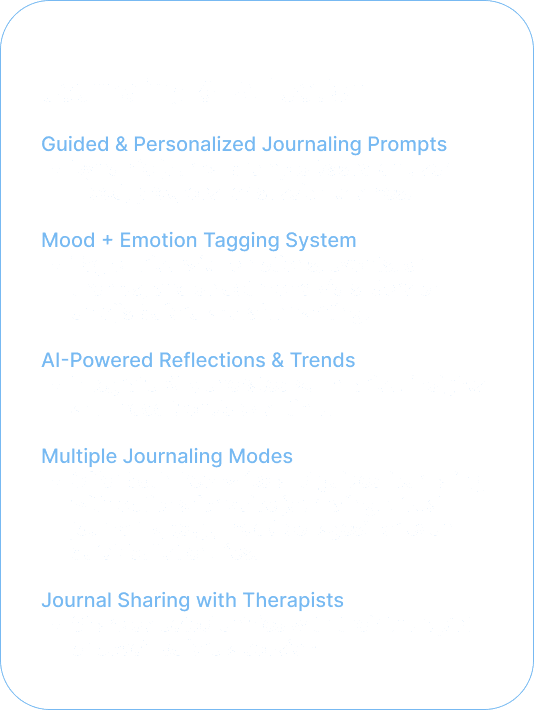
Based on these insights, I defined three core solution pillars to deliver personalized, engaging, and continuous mental health support.Three pillars for personalized, engaging, continuous support.
Each pillar addresses a critical breakdown in existing platforms while leveraging spatial interaction to enhance user engagement and emotional connection.Each pillar fixes a key gap in existing platforms, using spatial interaction to deepen engagement.
✧ Real-Life Use Scenario
To visualize how WellNest supports users across different moments, I mapped a real-life scenario from self-guided support to professional care.A real-life scenario, from self-guided support to professional care.
This scenario illustrates how users move from self-guided support to professional care within a single experience.
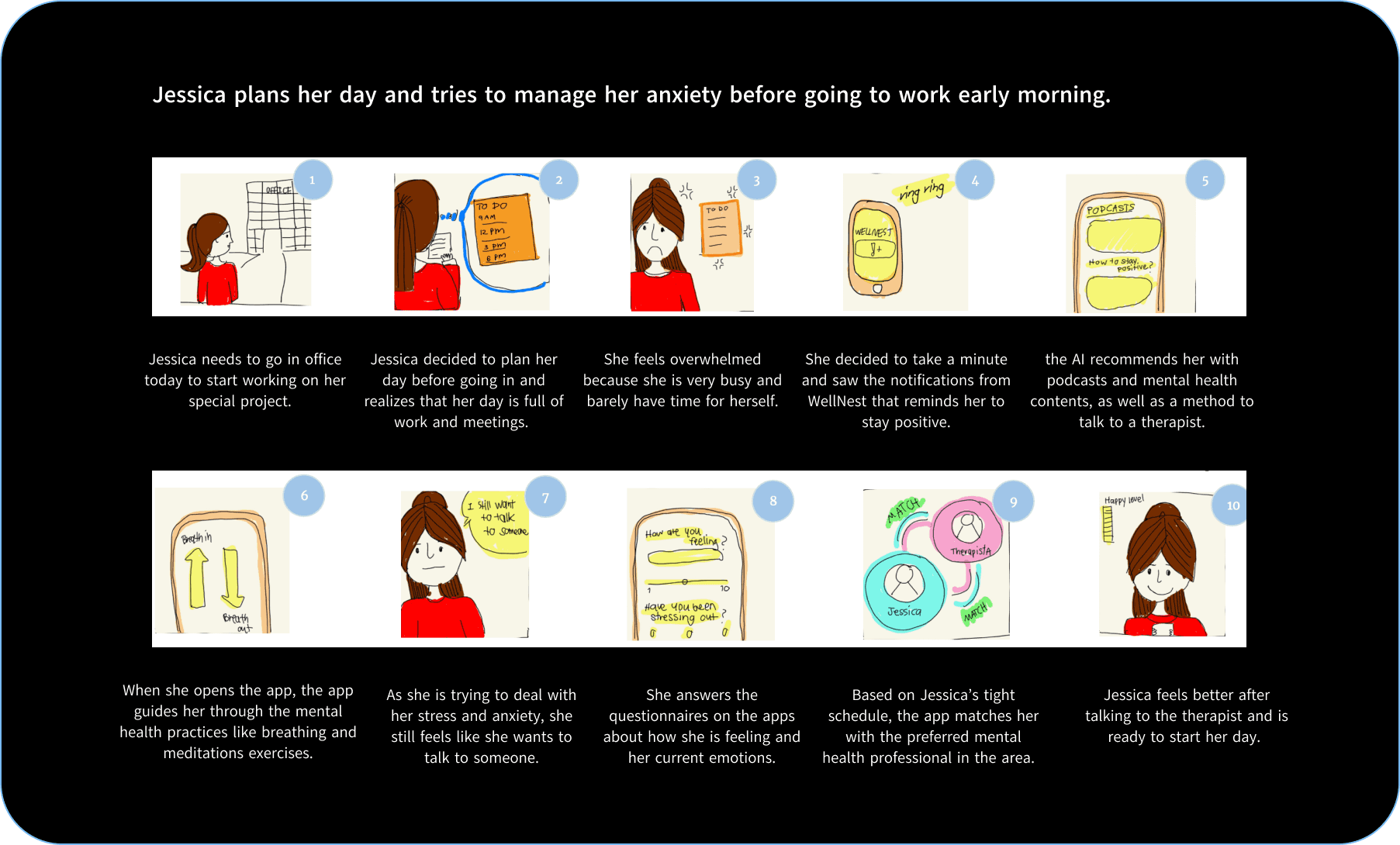
This scenario informed the design of WellNest’s adaptive support flow, ensuring users can transition seamlessly between independent coping tools and professional guidance.This scenario shaped WellNest’s adaptive flow, letting users move smoothly between self-guided tools and professional care.
✧ End-to-End Experience
WellNest was designed as a connected ecosystem rather than a collection of isolated features. The experience flows seamlessly from therapist matching to guided support, progress tracking, and reflection.One connected ecosystem, from matching to reflection.
Each stage supports users across different emotional states, building trust, engagement, and long-term motivation over time.
User Journey
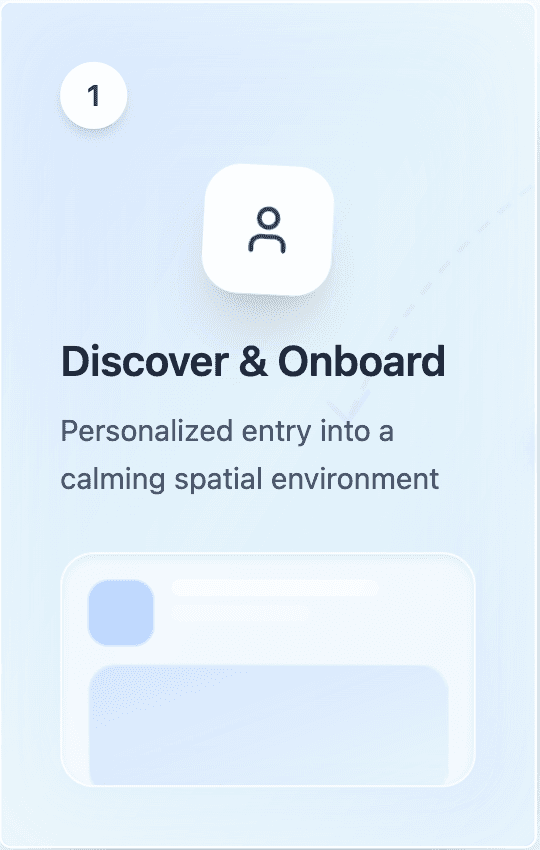
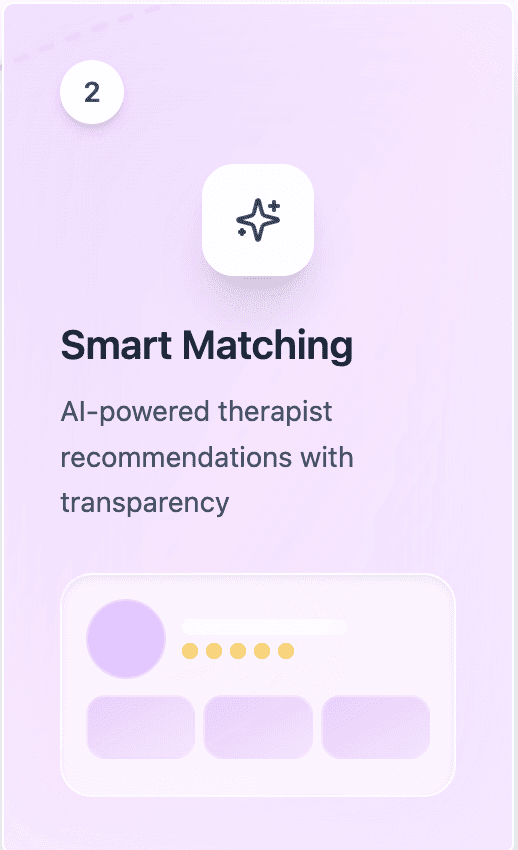
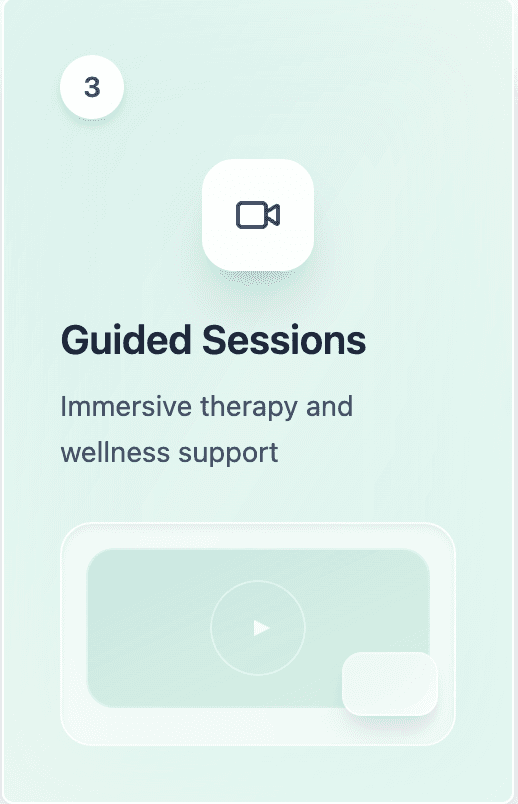
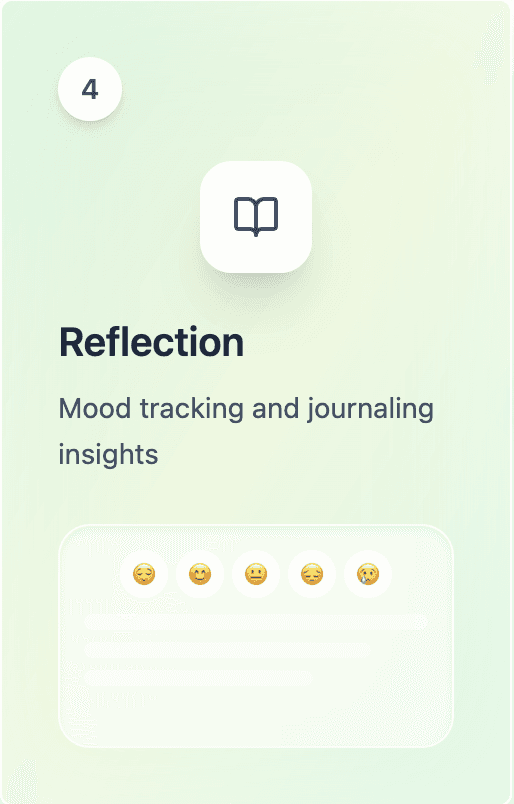
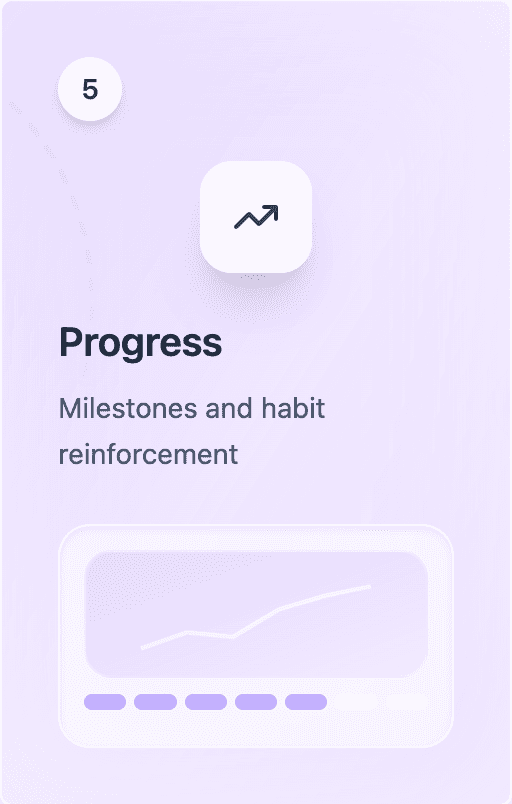
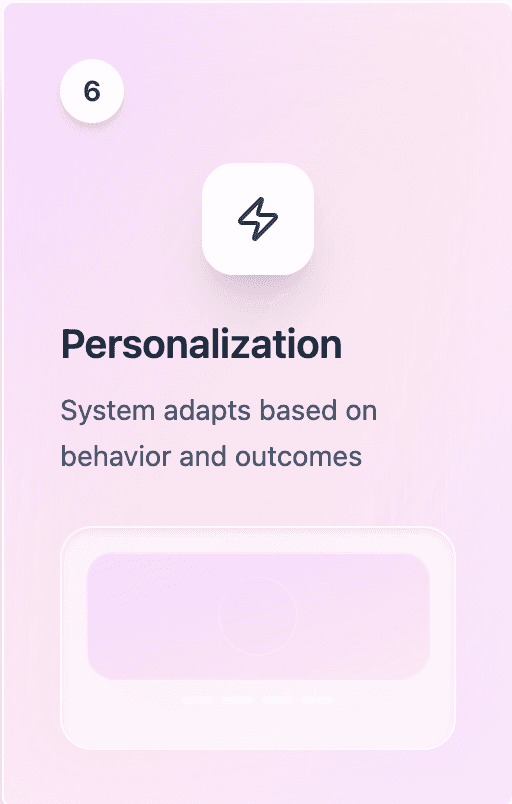
One of the most critical moments in this journey is helping users find the right support quickly and confidently.
SOLUTION
✧ Feature 1: Smart Matching System
WellNest is designed to make finding the right support feel effortless.
By connecting users with therapists aligned to their needs, preferences, and availability, the smart matching system goes beyond surface-level pairing to create a truly personalized experience.Smart matching pairs users with therapists by needs, preferences, and availability, going beyond surface-level matching.
Design Decisions
Progressive Intake
Reduced cognitive load and improved completion rates during onboarding.
Therapist Preview Cards
Built trust before commitment and reduced uncertainty when choosing support.
Matching Transparency
Helped users understand recommendations and increased confidence in the system.
Once users are connected with the right support, the experience extends into daily wellness practices that reinforce progress between sessions.
✧ Feature 2: Wellness Exercises
WellNest provides adaptive wellness exercises that help users manage stress in the moment while building sustainable habits over time.Adaptive exercises for stress in the moment and habits over time.
Many users struggle to maintain consistent wellness routines without guidance or feedback. To address this, I designed a library of bite-sized exercises such as breathing, meditation, and grounding practices that adapt based on user mood, progress, and engagement patterns. These activities reduce friction while reinforcing long-term behavior change.Routines are hard to keep without guidance. I designed bite-sized breathing, meditation, and grounding exercises that adapt to mood, progress, and engagement, reducing friction and building lasting habits.
Design Decisions
Bite-sized Activities
Lowered friction for busy users and encouraged consistent engagement.
Mood-based Recs
Connected exercises to emotional context instead of static content libraries.
Progress Tracking
Reinforced motivation and habit formation over time.
Beyond guided exercises, reflection plays a key role in sustaining emotional growth.
✧ Feature 3: Journaling
WellNest integrates guided journaling and mood tracking to help users reflect, recognize patterns, and build emotional awareness over time.Guided journaling and mood tracking to build emotional awareness.
Reflection is a critical part of mental health progress, yet many tools lack structure or personalization. I designed guided prompts, mood tracking, and AI-generated insights that evolve based on user behavior and therapy sessions, creating a continuous feedback loop between self-reflection and professional support.Reflection drives progress, but most tools lack structure. Guided prompts, mood tracking, and AI insights adapt to behavior and therapy sessions, linking self-reflection with professional support.
Design Decisions
Guided Prompts
Reduced decision fatigue and helped users start reflection more easily.
Mood Tagging
Supported self-awareness and pattern recognition.
AI-generated Summaries
Turned raw entries into actionable reflection.
FEEDBACK & ITERATIONS
✧ Design Iterations
Design is an iterative process.
Throughout the design process, I gathered feedback from peers and mentors to refine usability, clarity, and engagement. These iterations helped strengthen the overall experience and align the interface more closely with user needs.Feedback from peers and mentors helped refine usability, clarity, and engagement, bringing the interface closer to user needs.
1. Therapist Matching Experience
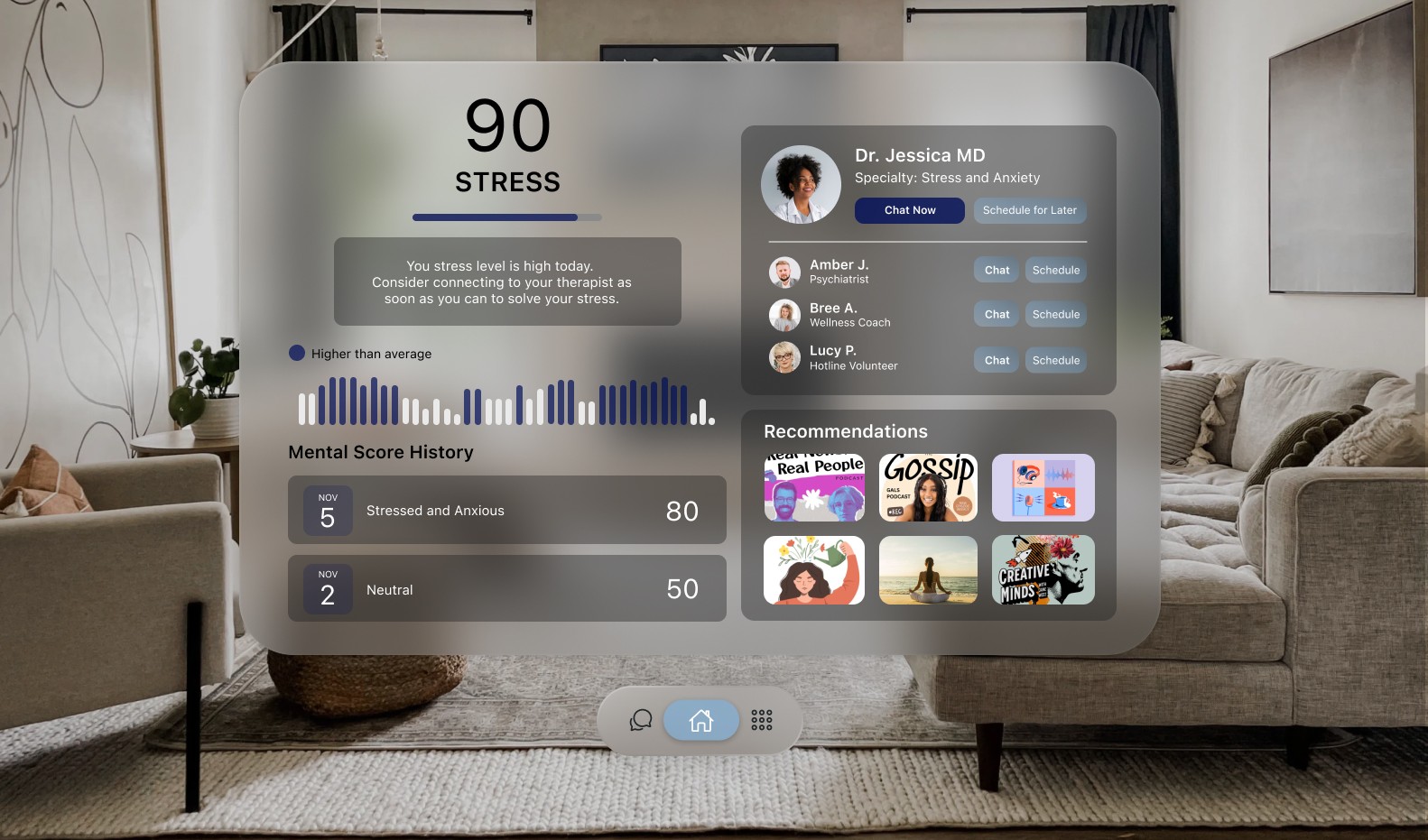
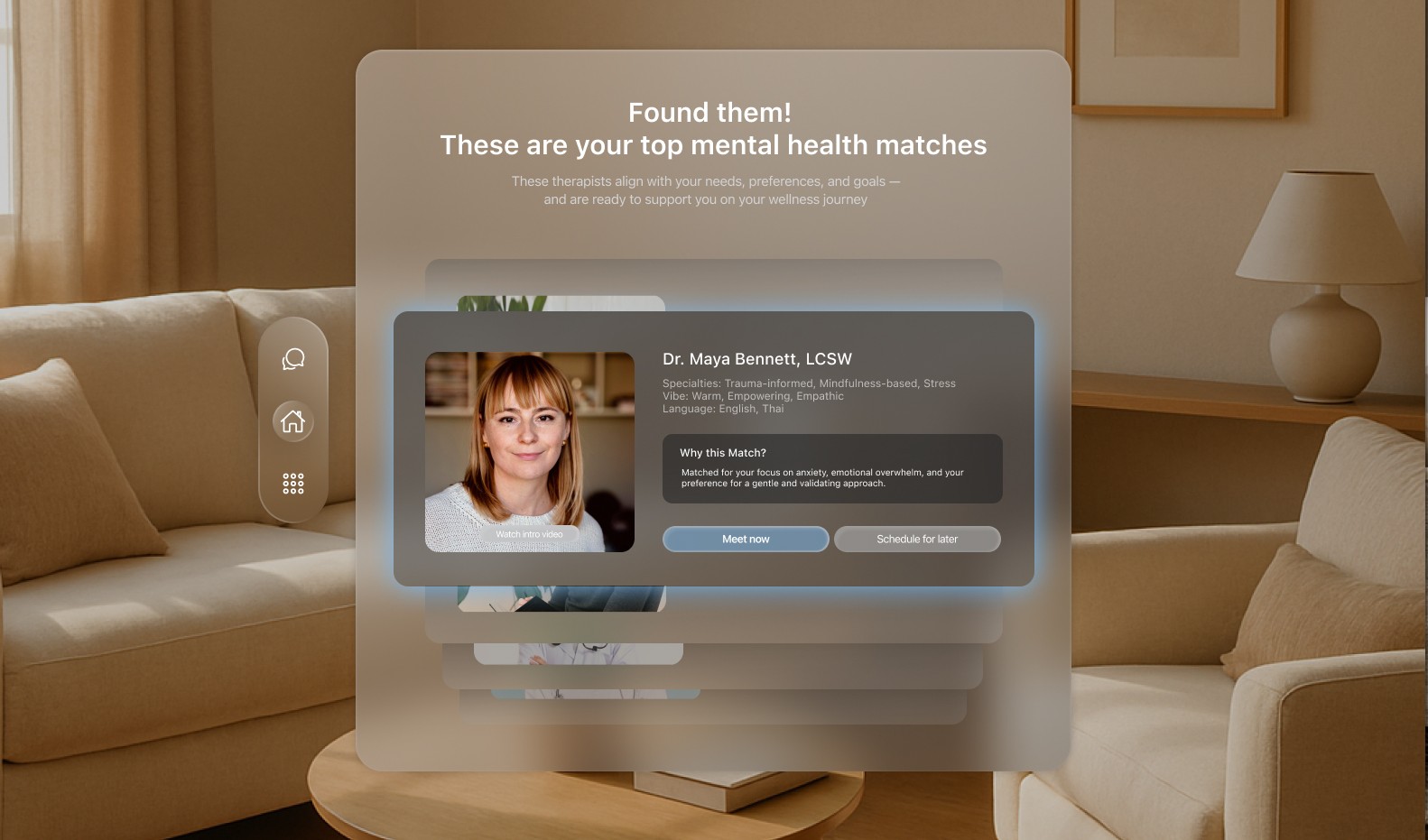
Problem
Users were given data but no clear next step, forcing them to interpret their state and decide what to do on their own.Users saw their data but had no clear next step.
What Changed
I shifted the experience from a multi-section dashboard to a guided flow that prioritizes the next best action — connecting with a therapist.A guided flow now leads to the next best action: connecting with a therapist.
Outcome
This reduced cognitive load, clarified next steps, and made the experience feel more supportive and human rather than analytical. This increases the likelihood that users take action instead of dropping off after viewing their results.Less cognitive load, clearer next steps, fewer drop-offs.
2. From Form-Based Input to Conversational Onboarding
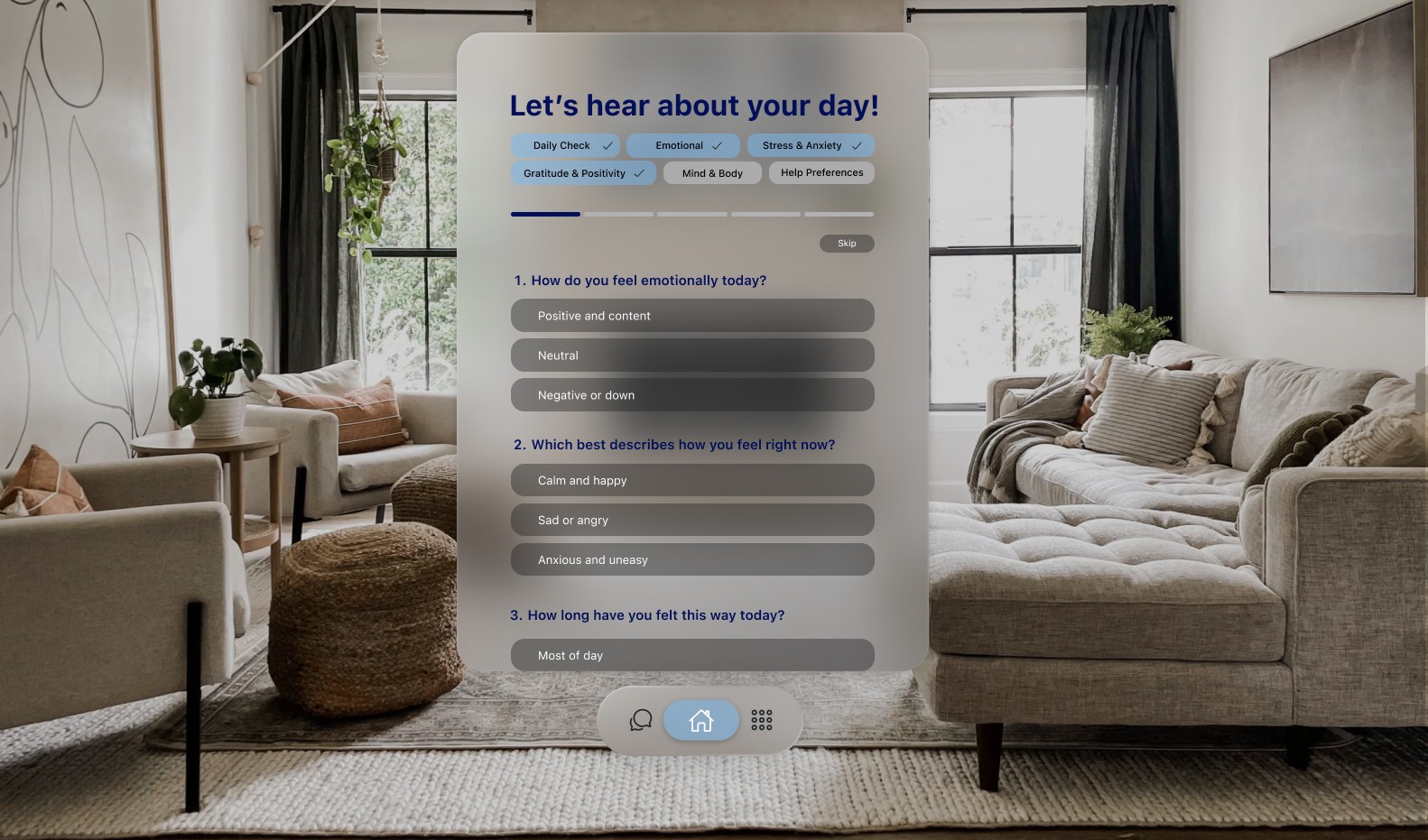
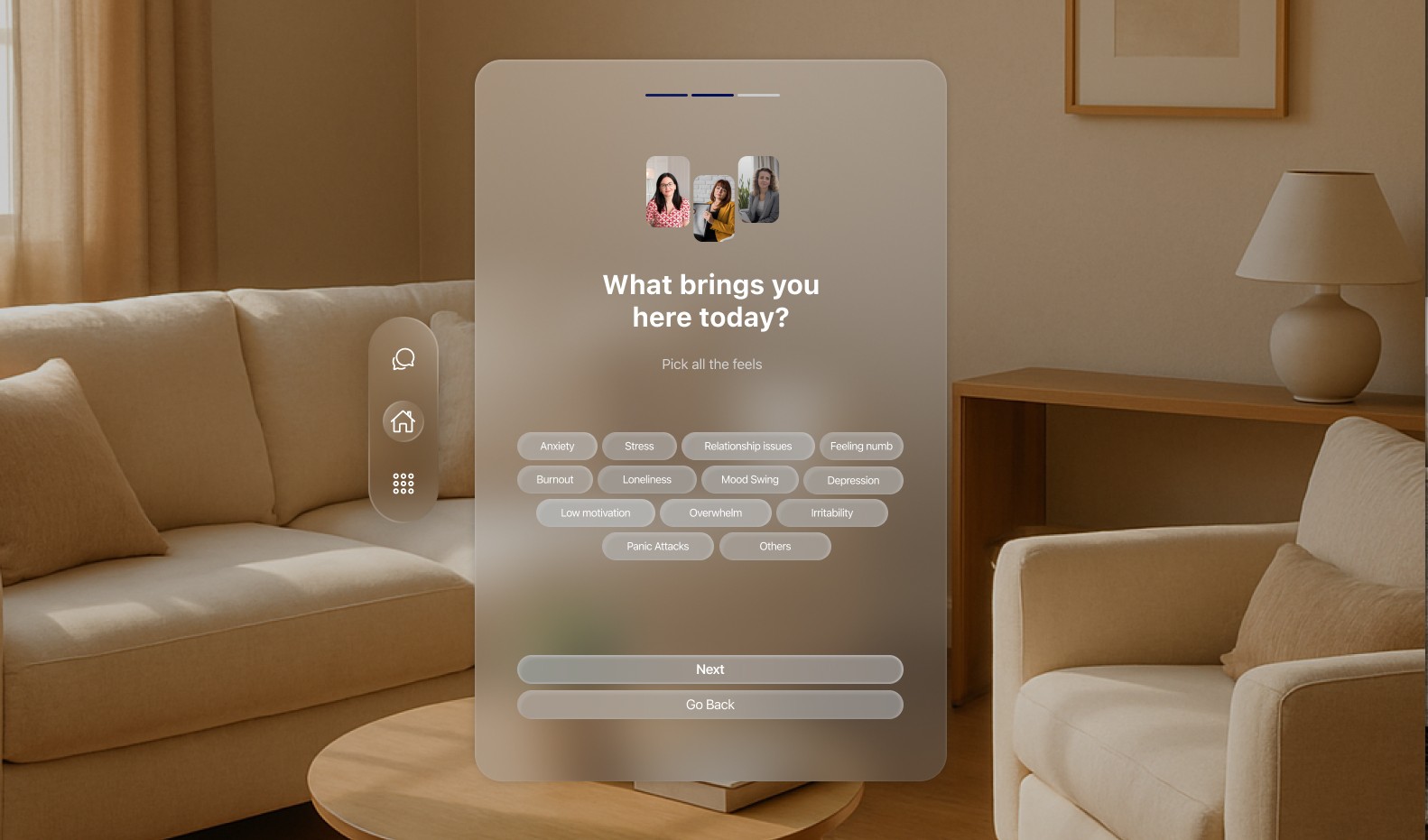
Problem
The onboarding used a multi-step form that felt rigid and required users to overthink their emotions upfront.A rigid multi-step form made users overthink their emotions.
What Changed
Shifted from a structured form to a conversational flow with simple prompts and selectable options, making it easier for users to express how they feel.A conversational flow with simple prompts and selectable tags.
The use of selectable tags allows users to recognize their feelings instead of having to articulate them, lowering the effort required to engage.Selectable tags let users recognize their feelings instead of putting them into words.
Outcome
Reduced friction, increased engagement, and made it easier for users to continue toward therapist matching.Less friction and a smoother path to therapist matching.
3. Wellness Exercise Experience
Problem
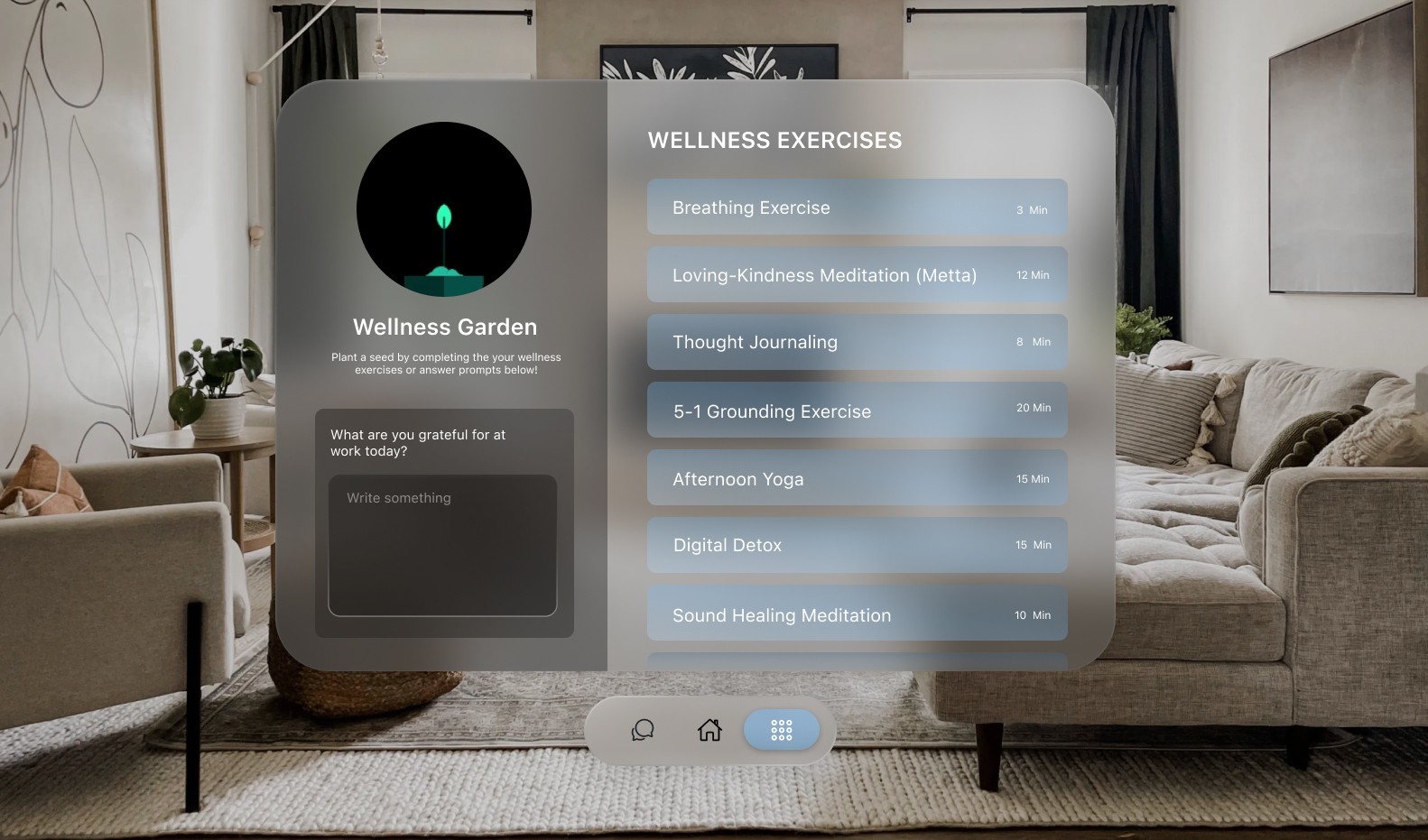
The initial experience presented exercises as a static list, making it hard for users to know what to do or where to start.A static list left users unsure where to start.
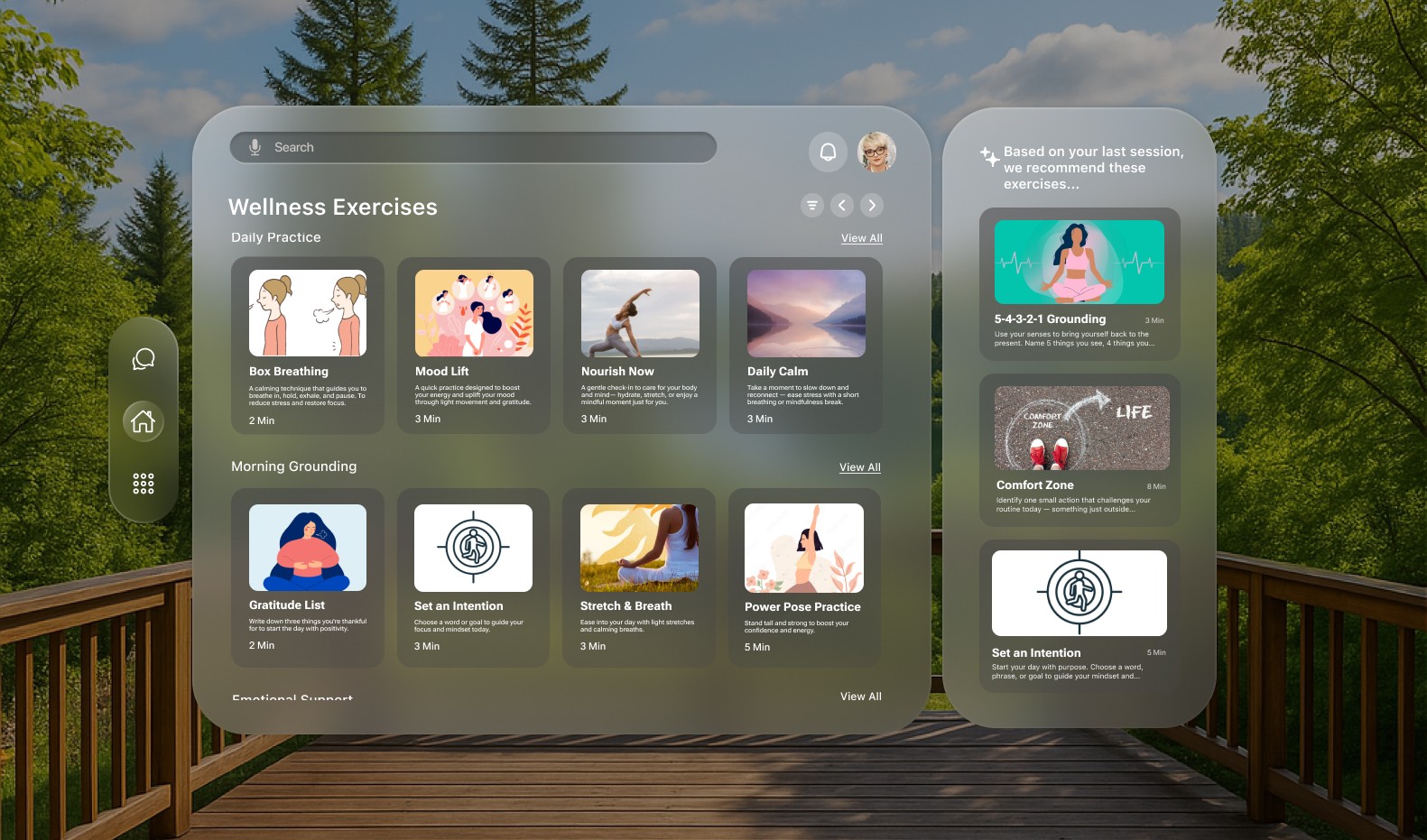
What Changed
I shifted from a list-based layout to a more structured and personalized experience, organizing exercises into categories and surfacing recommended actions based on user context.Exercises are now grouped into categories, with recommendations based on the user’s context.
Outcome
Improved discoverability, reduced decision fatigue, and made it easier for users to start and stay engaged with exercises.Easier to discover, start, and stick with exercises.
OUTCOME & PROTOTYPE
✧ Impact & Expected Outcomes
WellNest aims to improve access to mental health support while increasing user engagement and long-term habit formation.Better access to support, deeper engagement, lasting habits.
By combining adaptive recommendations, immersive environments, and progress tracking, the platform supports users across different stages of their wellness journey while reinforcing sustainable behavior change over time.Adaptive recommendations, immersive environments, and progress tracking support users at every stage and build lasting habits.
Expected Impact
Increased accessibility
Faster access to mental health support through intelligent therapist matching.
Improved engagement
Higher user interaction driven by immersive and personalized experiences.
Stronger habit formation
Sustained wellness routines supported by progress tracking and adaptive guidance.
REFLECTION
✧ What I Learned
Mental health experiences are deeply personal, which means design decisions carry real emotional impact.
Through this project, I learned the importance of balancing guidance with flexibility when designing for sensitive experiences. Users needed support without feeling overwhelmed, which influenced decisions around progressive disclosure, personalization, and interaction simplicity.Designing for sensitive moments means balancing guidance with flexibility: support without overwhelm, through progressive disclosure, personalization, and simple interactions.
Designing the smart matching system reinforced how critical empathy and context are when connecting users with the right resources. I also gained experience structuring complex workflows into clear, intuitive journeys that support both immediate needs and long-term engagement.Smart matching showed how much empathy and context matter.
This project strengthened my ability to translate research insights into product strategy while considering emotional, behavioral, and usability factors simultaneously.